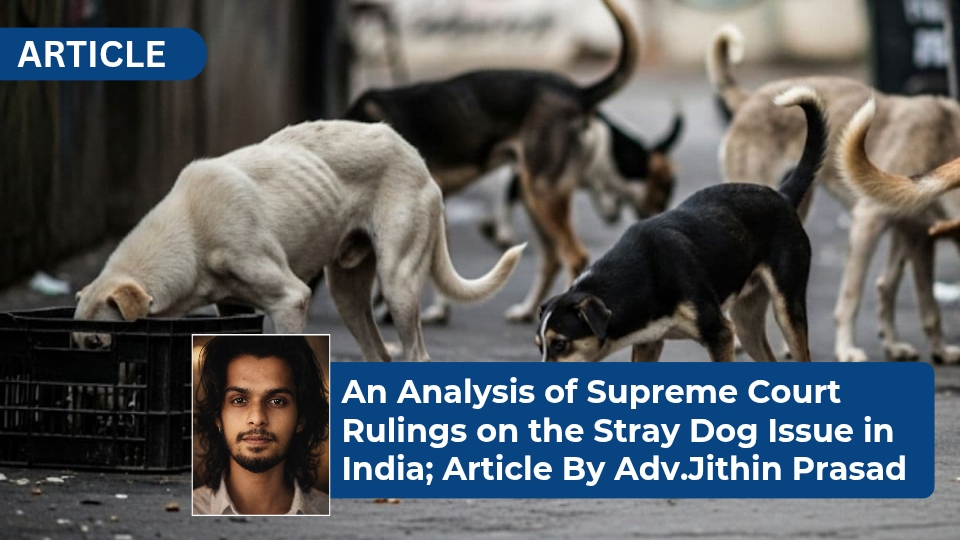
The issue of stray dogs in India has long occupied a sensitive space at the intersection of public safety, public health, animal welfare and constitutional governance. Frequent incidents of dog bites, rabies-related deaths and road accidents have led to increasing public concern while animal welfare groups stress humane treatment and protection of street animals. In recent proceedings, the Supreme Court of India has revisited this complex issue attempting to strike a workable balance between human safety and animal rights within the existing statutory framework. The Court’s observations and interim directions mark an important moment in the evolving jurisprudence on human–animal conflict in urban India.
The management of stray dogs in India is primarily governed by the Prevention of Cruelty to Animals Act, 1960 and the Animal Birth Control (ABC) Rules, 2023. These rules emphasize sterilisation, vaccination, and humane treatment rather than culling or indiscriminate removal. Local authorities are entrusted with the responsibility of implementing these measures in coordination with animal welfare organisations. However uneven enforcement, lack of infrastructure and rapid urbanisation have resulted in a growing stray dog population in many cities. This administrative failure has increasingly been brought before constitutional courts where citizens seek protection of their fundamental rights particularly the right to life and personal safety under Article 21 of the Constitution.
In its recent hearings, the Supreme Court has taken a noticeably pragmatic approach. Rather than treating the matter as a binary conflict between animal lovers and victims of dog attacks, the Court has repeatedly underscored that constitutional adjudication must be rooted in ground realities. The Bench has observed that public safety cannot be compromised in the name of abstract compassion while simultaneously reiterating that animals are entitled to humane treatment. Importantly, the Court has clarified that it has not ordered a blanket removal of all stray dogs from public spaces. Instead, its focus has been on ensuring strict compliance with the ABC Rules and identifying sensitive zones where human safety must take precedence. This clarification is significant as it corrects widespread public misunderstanding generated by fragmented media reporting.
One of the most impactful aspects of the Supreme Court’s approach has been its emphasis on creating dog-free zones in specific public and institutional areas. The Court has indicated that places such as schools, hospitals, courts, bus stands, railway stations, and similar high-footfall locations cannot be treated at par with ordinary residential areas. In such spaces, the presence of stray dogs poses a disproportionate risk especially to children, elderly persons, and patients. By directing municipal authorities to ensure that these areas are free from stray dogs the Court has effectively prioritised the right to safe access to public institutions. At the same time, it has insisted that removal from these zones must be carried out humanely with due regard to sterilisation, vaccination and rehabilitation wherever feasible.
Another contentious issue addressed by the Supreme Court relates to the feeding of stray dogs in public places. While acknowledging that feeding animals is often motivated by compassion, the Court has expressed concern that unregulated feeding can exacerbate territorial aggression and increase risks to the general public.The Court’s stance reflects a middle path: feeding cannot be entirely prohibited, but it must be regulated. Designated feeding zones identified by local authorities are seen as a practical solution that accommodates animal welfare without endangering public safety. This approach recognises that individual rights and moral choices cannot override collective safety in shared public spaces.
A notable feature of the Court’s recent observations is its insistence on scientific and administrative solutions rather than emotional arguments. The Bench has highlighted the need for reliable data on dog populations, vaccination coverage, and bite incidents. Measures such as microchipping, geo-tagging, and proper record maintenance have been discussed as tools to enhance accountability and effectiveness. By doing so, the Supreme Court has subtly shifted the discourse from ideological confrontation to evidence-based governance. This signals a broader judicial expectation that executive authorities must adopt modern data-driven methods to address public health and safety concerns.
At the constitutional level, the stray dog issue presents a classic balancing exercise. On one hand lies the human right to life, health, and safety under Article 21. On the other lies the constitutional ethos of compassion towards living creatures reflected in Article 51A(g) and the jurisprudence recognising animal welfare as a facet of a civilised society. The renewed judicial scrutiny places a heavy responsibility on municipal bodies and state governments. Courts have repeatedly emphasized that the stray dog problem is fundamentally an issue of governance not litigation. Failure to implement sterilisation drives, vaccination programmes, and shelter facilities cannot be justified by citing financial or logistical constraints. The Supreme Court’s observations may also embolden citizens to demand greater accountability from local authorities. If effectively enforced these directions could serve as a catalyst for long-overdue reforms in urban animal management.
In sum, the Supreme Court’s evolving jurisprudence on stray dogs demonstrates a mature constitutional balancing exercise. By recognizing both human vulnerability and animal dignity, the Court has articulated a framework that is legally sound and socially responsive. The ultimate success of this framework depends on sincere implementation, institutional accountability, and informed civic participation. Ultimately, the stray dog debate is not merely about animals on the streets; it is about the kind of society India aspires to be—one that is humane, rational, and capable of protecting both human dignity and animal life through the rule of law.