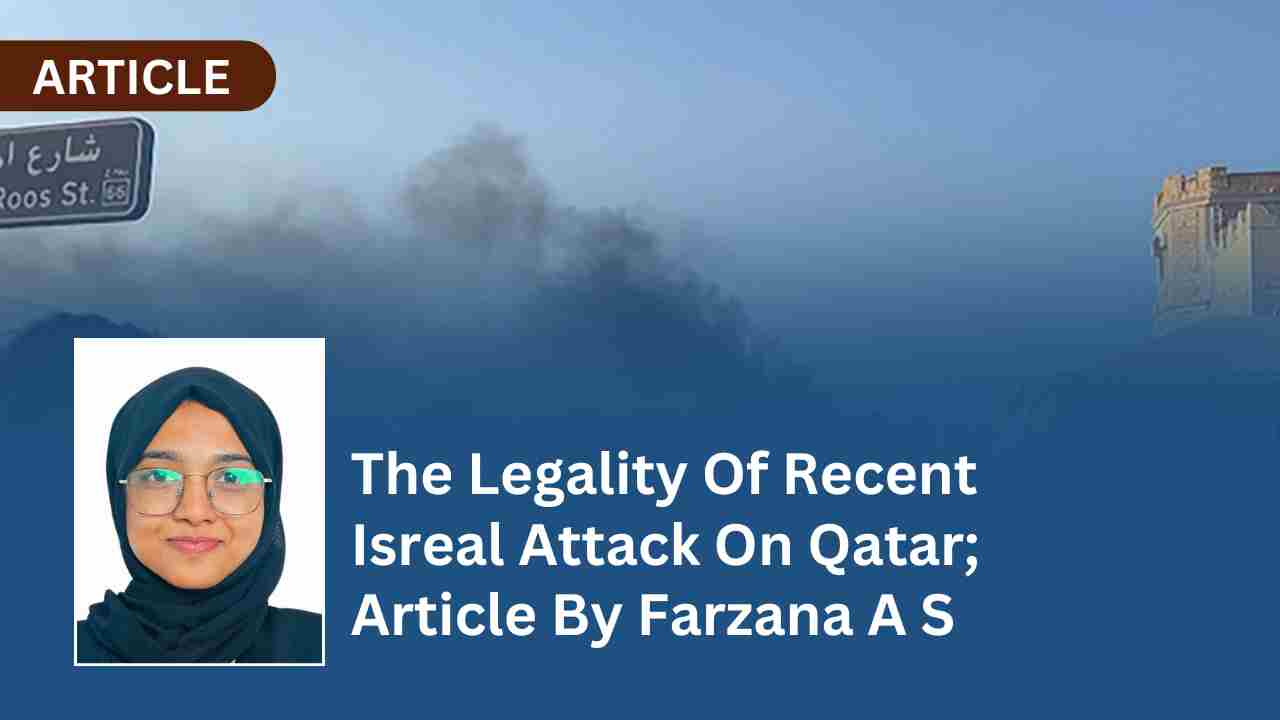
Israel carried out an airstrike in Doha, Qatar, targeting a compound said to house senior Hamas leaders engaged in ceasefire negotiations. The strike, named Operation Summit of Fire, sought to eliminate senior Hamas figures holding influential political and military roles, who reportedly survived. Hamas confirmed six deaths, including the son of chief negotiator Khalil al-Hayya, his office director, three lower-level Hamas members, and a Qatari security officer. The attack caused significant damage to a residential and office compound in Qatar and Qatar’s Interior Ministry also reported civilian injuries.
Israel has previously targeted Hamas leaders outside Palestinian territories, but only within the borders of enemy states. This strike marks the first time it has launched an attack against a sovereign nation, actively mediating the Gaza conflict and the release of Israeli hostages. Qatar maintains direct channels with the United States, Israel, and Hamas, and has repeatedly hosted high-level negotiations. Notably, during the October 7 massacre, Qatar had facilitated an agreement to act as a mediator between Israel, Hamas, and Egypt, in coordination with the United States, to allow the release of foreign nationals and critically injured Palestinian civilians from Gaza into Egypt.
On the preceding sunday, the U.S. President Donald Trump delivered what he termed a “last warning” to Hamas to accept a peace proposal intended to end the 2-year conflict, prematurely announcing that Israel had accepted it when the Israeli officials had only noted they were “seriously considering” it. The task of bridging the gap fell to Qatar, whose negotiators engaged in overnight discussions, with Hamas pledging to respond within 12 hours. Yet, before the deadline, Israeli missiles struck a residential building in Doha, believed to be sheltering senior Hamas leaders. Following the attack, the Israeli Prime Minister’s Office posted on X, asserting full and independent responsibility of the attack: “Israel initiated it, Israel conducted it, and Israel takes full responsibility”.
Israel justified the attack on multiple grounds, citing recent Hamas attacks in Jerusalem and Gaza, including the October 7 massacre. Netanyahu and Defense Minister Katz claimed that Hamas leaders continued to target Israeli civilians, denounced Qatar for providing a ‘safe haven’ to Hamas, and warned that terrorist leaders would no longer enjoy immunity. The Israeli ambassador to the US also indicated that further efforts to target Hamas leaders in Qatar or elsewhere could follow. Qatar condemned the strike as reckless and a violation of international law, noting that Hamas officials were hosted at the U.S.’s request to maintain communication channels. The Qatari Prime Minister described it as ‘state terror’ and called for Netanyahu to be held accountable.
Whether Israel’s action of executing an unprecedented strike on Qatar’s territory can be justified under the light of International law?
With Israel defending its strike on Qatar as a retaliation against Hamas, and Qatar seeking to hold Prime Minister Netanyahu accountable for violating its sovereignty, the key question before us is whether Israel’s action can be legally justified under international law, or whether it exposes the state to the legal consequences Qatar may pursue through international mechanisms.The UN Secretary-General António Guterres denounced the attack as a “flagrant violation” of Qatar’s sovereignty, highlighting its mediating role. At Qatar’s request, the UN Security Council held an emergency session where multiple states condemned Israel and called for accountability under international law. Building on these concerns, let’s delve into the legality of the strike through the framework of UN charter. The UN Charter safeguards the sovereignty of nations by prohibiting the use of force against the political independence or territorial integrity of states under Article 2(4), which is considered a considered ‘a cornerstone of the United Nations Charter. However, Article 51 recognises two key exceptions to this prohibition: first, the inherent right of individual or collective self-defence in response to an armed attack; and second, measures taken under the authorisation of the Security Council to maintain or restore international peace and security. These are the recognised grounds on which the use of armed force by a State can be justified today on the basis of the current norms in international law.
In this context, the “unwilling or unable” doctrine (UUD) has developed as a means of a state’s right to self-defence when attacks originate from the territory of another state. According to the UUD, a victim state (the “threatened state”) may use force against persons located in another state (the “territorial state”) without the United Nations Security Council’s authorization or the territorial state’s consent, provided that those persons pose an imminent danger to the threatened state and the territorial state is “unable or unwilling” to neutralize the threat. The doctrine was first invoked in the 1970s by the US in Cambodia against the North-Vietnamese forces and later by Israel in the 1976 Entebbe raid. After the September 11, 2001 attacks by the Al-Qaeda, it gained wider acceptance as a justification for counterterrorism operations by states such as the US and Israel.
The ‘unwilling or unable’ doctrine allows a state to use force without the host state’s consent when the latter cannot or will not prevent threats emanating from its territory. While rooted in gaps and ambiguities in international law, evolved from the treaties and customs, the doctrine is still debated. Critics warn that it may violate sovereignty and Article 2(4) of the UN Charter, whereas proponents invoke Article 51 on self-defence. Nevertheless, its application requires careful scrutiny, clear evidence of the host state’s inability or unwillingness, and exhaustion of peaceful means. As Israel’s claim aligns with the defences invoked under Article 51 for self-defence, it is necessary to examine whether the claim satisfies the 3 criteria of the doctrine to attract the right, assuming it is a well-recognized practice under international law.The first threshold for self-defense under Article 51 is that the act must constitute an armed attack. The ICJ in Nicaragua v. United States (1986) held that the gravity and effects of an act define an “armed attack” after the September 11, 2001 attacks against the US by the al-Qaeda group, it became widely accepted that large-scale attacks by non-state actors can trigger self-defense.
The October 7, 2023 Hamas attacks, causing around 1,200 deaths and mass hostage-taking, clearly meet this threshold, permitting Israel to invoke Article 51.Another key element of self-defence is proportionality. The ICJ has affirmed that force used in response to an ‘armed attack’ must be necessary and proportionate. Proportionality requires that the anticipated military advantage be weighed against possible civilian harm and directed toward neutralizing ongoing threats, with violations potentially amounting to war crimes under the Rome Statute of the International Criminal Court (ICC). Israel justified the strike as an effort to disrupt Hamas leadership and weaken its capacity. While such targeting may be proportionate if addressing an ongoing threat, most figures responsible for the October 7, 2023 attacks had already been neutralized, reducing the immediate risk.
The strike instead of the targeted Hamas senior leaders killed the Hamas negotiators engaged in U.S.-brokered ceasefire talks, leaving the proportionality of the operation legally uncertain.The next condition for exercising self-defense is that the territorial state must be in default of its obligation to prevent or stop hostile activities originating from its territory. The doctrine allows a victim state to use force in another state’s territory only if the territorial state is either unwilling or unable to prevent its territory from being used by an organized armed group (OAG) to launch attacks. A core prerequisite is that the victim state must give the host state clear notice and an opportunity to address the armed group, and the latter must either manifestly fail or refuse to act (‘unwillingness’) or lack the capacity to do so (‘inability’).”There is no public evidence that Israel made a prior demand for Qatar to expel Hamas personnel. The rationale behind such communication is that any use of force must be narrowly targeted to neutralize the threat, respect the host state’s sovereignty, and minimize harm to civilians. This is particularly critical in the densely populated area of Qatar’s capital, which includes embassies, schools, and residential compounds. Unilateral action on uncertain grounds, without prior demand for peaceful resolution, risks violating international law.
Further, territorial penetrations are permissible only if no viable alternatives exist and the force used is limited to defensive objectives. Even if a strike is justified by rare opportunities, it must be based on a strong, reasonable, and objective assessment in line with international norms and not merely on uncertain grounds. The strike’s failure to eliminate primary Hamas targets, alongside civilian harm, suggests deficiencies in planning and proportionality, which are the core legal requirements. Israel’s claim of a ‘rare opportunity’ is undermined by the fact that Hamas leaders were neither fleeing nor concealed, and Israel itself had been negotiating with them through Qatar, effectively accepting their presence. Ongoing talks, including a U.S.-brokered ceasefire discussed on the eve of the strike, complicate the claims that their presence alone justified the attack. The strike occurred just before that deadline, making it difficult for Israel to claim that Qatar’s alleged unwillingness or inability to act justified the attack or Qatar’s hosting of Hamas had suddenly become intolerable.Article 32 of the Regulations annexed to the 1899 Hague Convention II and 1907 Hague Convention IV provides that “a person is regarded as a parlementaire who has been authorized by one of the belligerents to enter into communication with the other, and who advances bearing a white flag.
He has a right to inviolability, as well as the trumpeter, bugler or drummer, the flag-bearer and interpreter who may accompany him.” This provision grants temporary protection from attack during official communications, provided their activities are strictly limited to negotiation. The Hamas-Israel negotiations, encompassing hostage exchanges, humanitarian aims, and a temporary cessation of hostilities, fall squarely within the purpose of the relevant rules, affirming the negotiators’ protected status and linking their immunity to contemporary conflict diplomacy.Considering the above legal analysis, the attack appears to fall short of the “unwilling or unable” standard, as Qatar was neither notified nor given a genuine opportunity to act, and deficiencies in operational planning caused significant harm to the State and its civilians and disregards the parlementaire immunity provided to facilitate the peace negotiation. Qatar has pursued legal action, with its chief negotiator meeting the ICC President in the Hague to seek Israel’s accountability under international law. Legal remedies pursued by Qatar focus on both international criminal accountability and the protection of its rights as a neutral mediator. On top of all of this, the strike’s aftermath has cast a grave shadow over Gaza’s prospects, it has strained Qatar’s mediating role in the Gaza conflict, undermined ceasefire and hostage negotiations, and heightened regional tensions. Prospects for hostage release and humanitarian relief in Gaza have diminished, with eroded trust risking prolonged civilian suffering and complicating future peace efforts.
REFERENCES
i) Gabriella Blum and John C P Goldberg, ‘The Unable or Unwilling Doctrine: A View from Private Law’ (2022) 63(1) Harvard International Law Journal 1
ii) ‘What do we know about Israeli strike on Hamas in Qatar?’ BBC News (London, 9 September 2025) https://www.bbc.com/news/articles/cq5jl77ygv4o accessed 25 September 2025.
iii) ‘Qatar’s Role in Mediation between Israel and Hamas’ CNN (1 November 2023) https://edition.cnn.com/2023/11/01/middleeast/qatar-mediation-israel-hamas-intl accessed 25 September 2025.
iv) UN Secretary-General, ‘Israeli Strikes in Qatar Risk ‘New and Perilous Chapter’ in Middle East Conflict, Under-Secretary-General Tells Security Council’ UN (9 September 2025) https://press.un.org/en/2025/sc16164.doc.htm accessed 25 September 2025.
v) ‘Qatar meets with ICC head to seek legal action over Israeli attack on Hamas leaders’ Times of Israel (Jerusalem, 18 September 2025) https://www.timesofisrael.com/qatar-meets-with-icc-head-to-seek-legal-action-over-israeli-attack-on-hamas-leaders/ accessed 25 September 2025.
vi) Charter of the United Nations (adopted 26 June 1945, entered into force 24 October 1945) 1 UNTS XVI
vii) Rome Statute of the International Criminal Court (adopted 17 July 1998, entered into force 1 July 2002) 2187 UNTS 3 (Rome Statute).
viii)Convention (II) with Respect to the Laws and Customs of War on Land (Hague II) (opened for signature 29 July 1899) 187 CTS 227
ix) Convention (IV) respecting the Laws and Customs of War on Land (Hague IV) (opened for signature 18 October 1907) 205 CTS 277
x) Case Concerning Military and Paramilitary Activities in and Against Nicaragua (Nicaragua v United States of America) 1986 ICJ Rep 14