INTRODUCTION
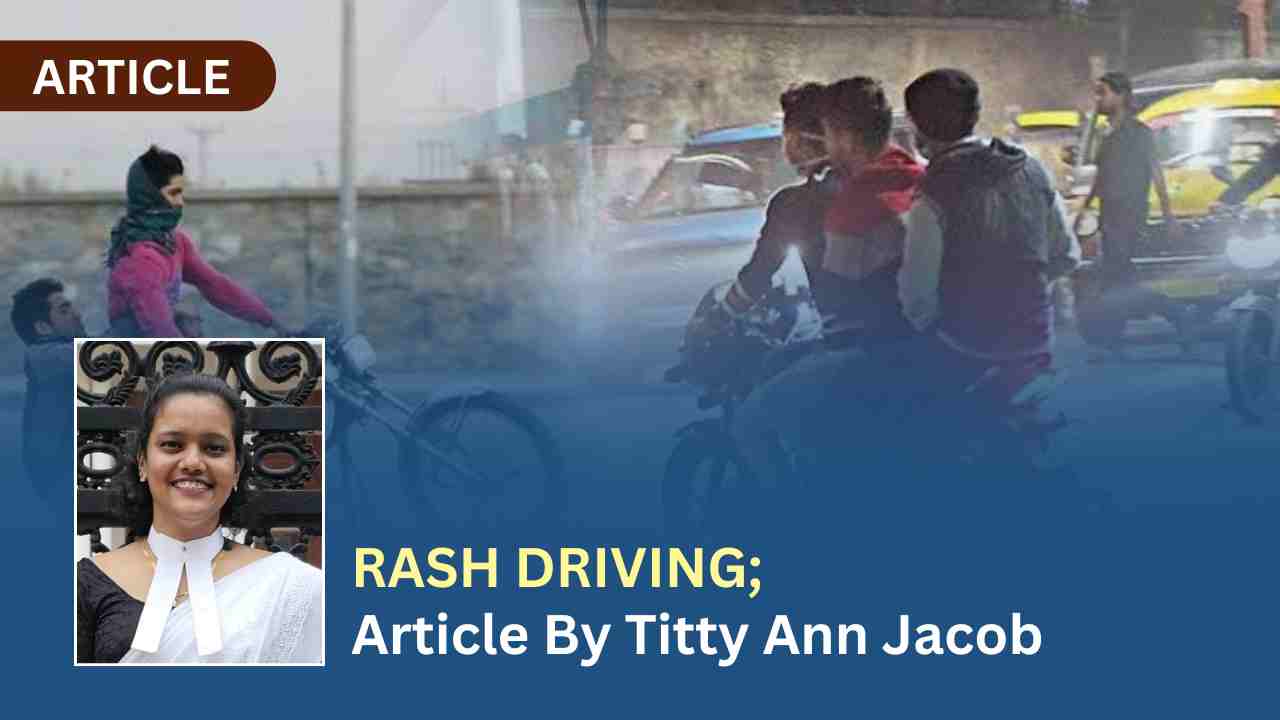
Rash driving” (or “rash and negligent driving”) refers to operating a motor vehicle in a manner that shows a disregard for safety (of the driver, passengers, pedestrians or other road users), often involving excessive speed, dangerous overtaking, wrongful use of road, failure to obey traffic signals, driving under influence, etc. It is not just about breaking traffic rules but doing so in a way likely to endanger life or cause injury.Bharatiya Nyaya Sanhita (BNS), 2023Section 281 Replaces older IPC Section 279. Defines rash driving or riding on a public way: driving/riding in a manner so rash or negligent as to endanger human life or likely to cause hurt or injury to any other person.Punishment up to 6 months imprisonment, fine up to ₹1,000, or both. BNS Section 106Section 106
(1)Causing death of a person by rash or negligent act (not amounting to culpable homicide) due to driving.Imprisonment may extend to 5 years, plus fine.BNS Section 106
(2)For cases of hit-and-run: causing death by rash / negligent driving and escaping without reporting.Punishment may extend to 10 years, plus fine. Motor Vehicles Act, 1988Section 185Driving under the influence of alcohol or drugs beyond permissible limits. Even when intoxicated, such driving that endangers life falls under this.
Penalties (fine, licence suspension, possible imprisonment) as per M.V. Act. (Exact penalties depend on first or subsequent offence, etc.) Motor Vehicles ActSection 183Speed limits: driving vehicles in violation of speed limit is an offense. It’s tied to rash driving because overspeed is often a component.
Indian Penal Code (old law, pre-BNS) Section 279The older law that BNS Section 281 replaced: “rash driving or riding on a public way”. Equivalent scope to BNS 281. Situation in Ernakulam District / KochiErnakulam (including Kochi city) has been witnessing serious issues with rash driving, private buses, and speeding vehicles. Some of the facts and recent cases:
The Motor Vehicles Department (MVD) records show thousands of speeding violations in the district. For example, in one month about 7,375 vehicles were booked in July for exceeding speed limits. There have been multiple accidents involving private buses allegedly driven rashly. A recent tragic example: An 18-year-old student was killed when a speeding private bus hit his scooter. The driver was booked under BNS Sections 281 (rash driving) and 106(1) (causing death by negligence). Another case: A private bus driver died in an accident involving a truck at Kundannoor; the truck driver was booked under Sections 281 and 106
(1) of BNS. There is also concern about enforcement. For instance, special drives by MVD to check private buses, and police verification / character certificate for drivers being suggested. Challenges in Enforcement
Despite the laws being fairly clear, several challenges persist in Ernakulam:
1.Evidence and proof issuesProving “rash” or “negligent” driving involves establishing not just speed but context (road conditions, visibility, vehicle condition, behaviour of driver). Sometimes procedural lapses (e.g. in drunk driving cases, failure to do breathalyser / medical tests properly) can lead to acquittals, though courts have held that even if drunk driving charge fails, rash driving charge (IPC / BNS 281) can continue.
2.Hit-and-run casesDrivers escaping scene of accident adds difficulty for victims to claim accountability. Under BNS Section 106(2), punishment for causing death and then escaping is increased, but enforcement of hit-and-run laws is often weak.
3.Overlapping laws and transition issuesWith recent changeover from IPC to Bharatiya Nyaya Sanhita, there is confusion about which section applies, how older cases are treated, and how new penalties impact existing judicial practice. Also overlapping jurisdiction between MVD, traffic police, etc.Human, administrative issues
Lack of constant enforcement; drives are sometimes periodic or reactive.Buses and commercial vehicles often commit repeat violations.Lack of good driver training / background checks in some cases.Public awareness is low about consequences, both legal and safety.
5.Infrastructure / road conditionsEven where roads are bad, drivers sometimes blame road design, traffic congestion, signage, lighting etc. While these don’t excuse rash driving, they are sometimes factors in how dangerous certain stretches are.Recent Changes and Legal Trends
The new law, Bharatiya Nyaya Sanhita (2023), provides for harsher punishments for causing death by rash or negligent driving. Under Section 106(1) up to 5 years; Section 106(2) up to 10 years for hit-and-run type cases. Courts in Kerala have affirmed that even if a drunk driving charge (under MV Act) is thrown out due to procedural issues, prosecutions under rash driving laws (BNS 281 / old IPC 279) may survive.
Kerala High Court has laid down procedural safeguards: e.g. in drunken driving cases, ensuring “air blank test” before breathalyser is mandatory so as to ensure the device is not contaminated. Non-compliance can lead to evidence being discarded. Suggestions / What Can Be Improved
To reduce rash driving and its harms in Ernakulam, following steps may help:
1.Stricter & continuous enforcementMore frequent traffic checks, speed enforcement (radar, speed cameras) on high-accident corridors.Enforcement of hit-and-run provisions, ensuring reporting of accidents, even for minor damage.
2.Driver licensing and background checksFor commercial/private bus drivers, require good medical fitness, mental fitness, clean driving record.Character certificates, police verification, etc., as some recent reports have suggested.
3.Public awareness campaignsEducating drivers about legal consequences under BNS (the new punishments), risk of causing death / injury.Pedestrians and general public awareness: right-of-way, importance of safer roads, temperature of enforcement etc.
4.Better infrastructure & road safety designMaintain road signage, lighting, road surface, proper pedestrian crossings.Planning bus stops, parking, overtaking zones to reduce conflict points.
5.Judicial and procedural reformsEnsuring evidence collection (e.g. speed data, CCTV footage) is systematic.Ensuring breathalyser / medical tests are done properly.Quick handling of cases involving serious offences (death or grievous hurt) to serve as deterrent.
6. Community participation, complaints systemsReporting rash drivers (private buses, etc.). Use helplines, apps, social accountability.Feedback from citizens, possibly stronger fines or penalties if repeat offences.
Conclusion
Rash driving is a serious issue in Ernakulam district. The legal framework under the BNS, MV Act, and older IPC provides strong deterrents, especially with updated punishment for causing death and hit-and-run cases. However, law alone cannot solve the problem. Enforcement must be consistent, legal and procedural lapses must be plugged, public awareness must be raised, and infrastructure improved. Only with a holistic approach can the number of accidents and fatalities due to rash driving be meaningfully reduced.